Choosing between Madonna di Campiglio and Cortina d'Ampezzo is not about picking the better mountain, it is about picking between two different ways of being in the mountains: Cortina is larger, more social and better known abroad, while Campiglio is smaller and has a wider ski area that is fully connected, with the lifts leaving from the village itself.
Cortina d'Ampezzo is in Veneto, at 1,224 meters in the middle of the Ampezzo basin, has around 5,500 residents and has hosted the Winter Olympics twice, in 1956 and in 2026.
Madonna di Campiglio is in Trentino, at around 1,550 meters in the upper Val Rendena, has just over 800 residents, and the choice between the two comes down to three concrete things: where you are travelling from, how much you want to ski without taking your skis off, and what kind of evening you are looking for.
The differences at a glance
- Ski area. Campiglio skis on more than 150 km of connected slopes and around 60 lifts on a single ski pass. Cortina has 120 km of slopes and 36 lifts, inside the Dolomiti Superski circuit, which brings together 1,200 km across 12 ski areas.
- Access to the slopes. In Campiglio the lifts leave from the center of the village and from some hotels you ski straight out. In Cortina the Faloria cable car and the Freccia nel Cielo leave from the village, but the three ski areas are not all connected on skis: between Faloria and Tofane you take the skibus.
- Size of the village. Cortina has around 5,500 residents, Madonna di Campiglio just over 800.
- Airports. Cortina is easier to reach from the east: Venice is around 160 km away, Treviso around 130. Campiglio is easier from the west: Verona is around 170 km and 2 hours 15 minutes away, Bolzano around 110 km and 1 hour 40.
- Altitude. The village of Cortina sits at 1,224 meters, Madonna di Campiglio at around 1,550.
Where they are and how to get there
Cortina d'Ampezzo is in Veneto, in the province of Belluno, at the center of the Ampezzo basin, in the upper Boite valley. The mountains around it, the Tofane, the Cristallo and the Sorapiss, are part of the Northern Dolomites.
Madonna di Campiglio is in Trentino, in the upper Val Rendena, a hamlet of the municipality of Pinzolo, between the Brenta Dolomites and the glaciers of the Adamello and the Presanella.
The two are just over 100 km apart as the crow flies, but the road follows the valleys and the passes: by car it takes between three and four hours. They are not two places you visit on the same trip.
From there on the logistical advantage depends on where you set off from, and it is worth saying in full. For Cortina the reference airports are Venice Marco Polo, around 160 km away, and Treviso, around 130 km, both served by scheduled coaches in a little over two hours; the nearest railway station is Calalzo-Pieve di Cadore, 35 km away.
For Madonna di Campiglio the airports are Verona at around 170 km and 2 hours 15 minutes, Bergamo Orio al Serio at around 175 km and 2 hours 40, Bolzano at around 110 km and 1 hour 40, Milan and Venice at around 3 hours 30. The nearest station is Trento, around 70 km away, served by high-speed trains.
If you are coming from Venice, from Treviso or from eastern Austria, Cortina is quicker to reach. If you are coming from Milan, Verona or Bergamo, Campiglio is quicker.
What the skiing is like in each
Madonna di Campiglio is part of the Skiarea Campiglio Dolomiti di Brenta Val di Sole Val Rendena: more than 150 km of slopes and around 60 lifts connecting Madonna di Campiglio, Pinzolo and Folgarida-Marilleva on skis, on a single ski pass. The ski area rises to around 2,500 meters.
What changes the shape of the day in Campiglio is something else: four lifts leave from the center of the village, and from some hotels on the slopes you step outside in the morning with your skis on, no car and no skibus.
Cortina has 120 km of slopes and 36 lifts, spread across Tofane, Faloria-Cristallo and Lagazuoi-Cinque Torri, plus the San Vito, Auronzo and Misurina areas. The highest run is the Bus de Tofana, at 2,742 meters, and the steepest is the Forcella Rossa, with a section at 62%.
You go up from the village in Cortina too: the Faloria cable car reaches 2,120 meters and the Freccia nel Cielo leaves the center towards the Tofana. Since 2021 the Cortina Skyline gondola has connected Tofane and Cinque Torri in about 15 minutes; between Tofane and Faloria, though, you still use the skibus or the car.
Cortina's ski pass is the Dolomiti Superski, which opens 1,200 km of slopes across 12 ski areas on the same card, along with the classic circuits such as the Sellaronda and the Giro della Grande Guerra. It is the number that weighs most in Cortina's favor: if you want to change valley every day, you have more choice there.
The character of the two villages
Cortina is a village of around 5,500 residents with a life of its own away from the slopes. Corso Italia is the pedestrian street of shops and cafés, and some guests come for a week on the snow without skiing a single day.
The village has been an Olympic host twice, in 1956 and in 2026, and you can hear it in the way it talks about itself. If you want evenings out, shop windows and a center that stays awake late even in January, Cortina works on a scale that Campiglio does not have.
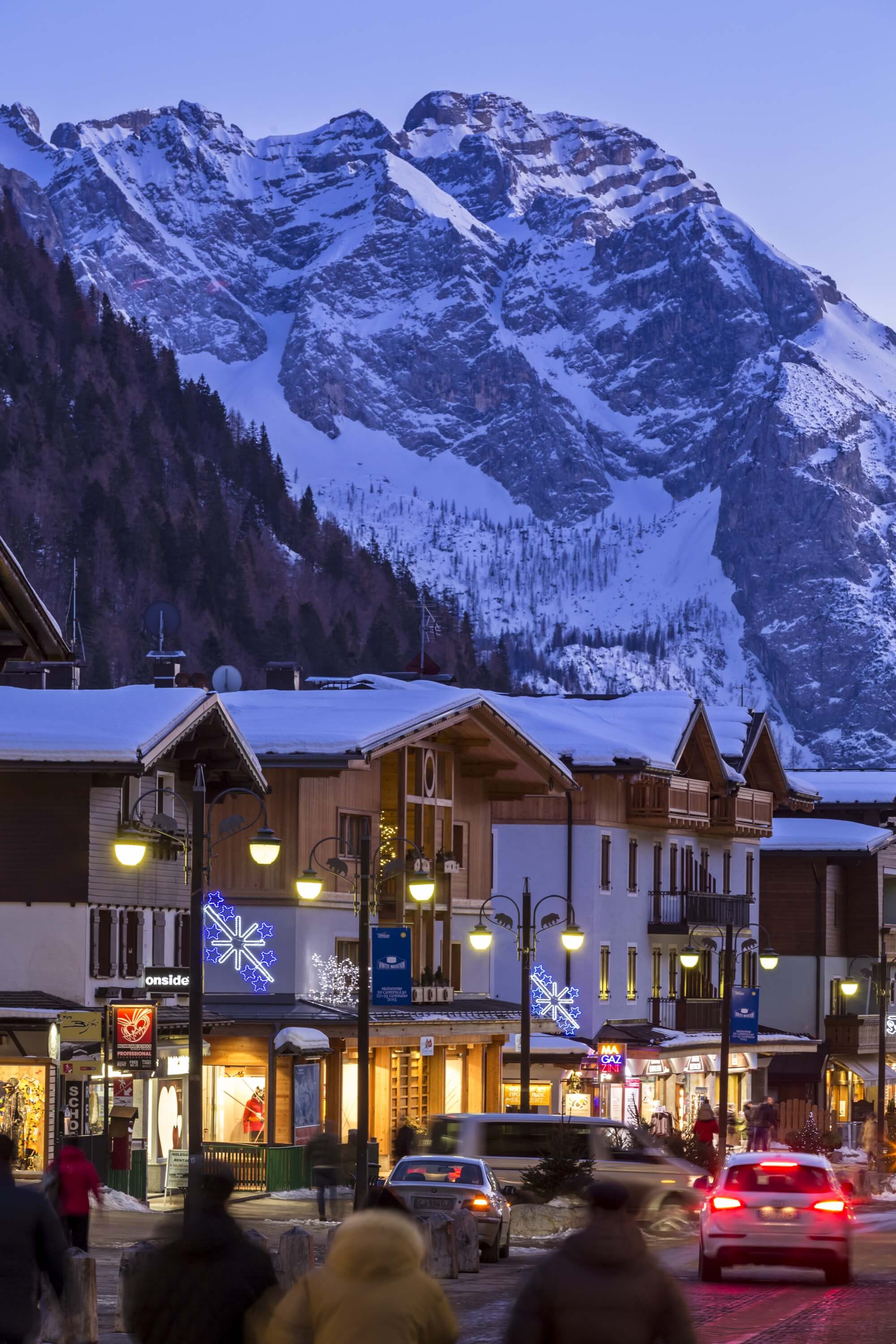
Madonna di Campiglio is more contained: just over 800 residents, and a center closed to traffic thanks to a ring road running through a tunnel, with the car parks on the edge of the village.
The story told here is the one of the Habsburg holiday tradition of the late nineteenth century, when Emperor Franz Joseph and Empress Elisabeth spent their holidays in the village. Every February that story comes back with the Carnevale Asburgico, first held in 1985: costumed processions, a ski run in period dress and the Emperor's Grand Ball in the Salone Hofer.
This is the dimension that decides more bookings than the kilometers of piste do, and it deserves the same attention as the numbers.
And in summer?
In summer the gap in fame between the two narrows, because the mountain counts for more than the name of the resort.
Madonna di Campiglio sits inside the Adamello Brenta Nature Park, the largest protected area in Trentino, around 620 km² with roughly 450 km of trails starting from the village or from the lifts, which run from mid-June to September. Waterfalls, high-altitude lakes and mountain huts are all within a day, and the three places not to miss in the Brenta Dolomites are a good place to start.
Cortina has the Dolomiti d'Ampezzo Nature Park, 11,200 hectares to the north of the village, managed by the Regole d'Ampezzo, with eight via ferratas, six equipped trails and eleven mountain huts. To the north it borders the Fanes-Senes-Braies park, and together they form a protected area of around 37,000 hectares.
The Dolomites are a UNESCO World Heritage site made up of nine mountain systems, and the two villages belong to different ones: the Brenta Dolomites for Campiglio, the Northern Dolomites for Cortina.
In both cases July and August stay cool while the lowlands swelter.
Choose Madonna di Campiglio if / Choose Cortina if
Choose Madonna di Campiglio if
- You want to ski without ever taking the car: the lifts leave from the center of the village.
- You want a wide ski area that is fully connected: more than 150 km on a single ski pass.
- You want a small village and a quiet evening after a day on the snow.
Choose Cortina if
- You want a village with shops, bars and an evening that runs late.
- You are interested in the via ferratas and the mountain huts of the Northern Dolomites.
Madonna di Campiglio and Cortina compared
| Madonna di Campiglio | Cortina d'Ampezzo |
|---|
| Location and region | Trentino, upper Val Rendena, hamlet of Pinzolo | Veneto, province of Belluno, Ampezzo basin |
|---|
| Altitude of the village | Around 1,550 m | 1,224 m |
|---|
| Reference airports | Verona 170 km, Bergamo 175 km, Bolzano 110 km | Venice 160 km, Treviso 130 km |
|---|
| Ski area and ski pass | More than 150 km and around 60 connected lifts, a single ski pass (Skiarea Campiglio Dolomiti di Brenta Val di Sole Val Rendena) | 120 km and 36 lifts across three areas, Dolomiti Superski pass (1,200 km, 12 ski areas) |
|---|
| Skiing from the village | Lifts from the center, ski-in/ski-out access from some hotels | Cable cars from the center (Faloria, Freccia nel Cielo), skibus between Tofane and Faloria |
|---|
| Character of the center | Closed to traffic with a tunnel ring road, just over 800 residents | Pedestrian Corso Italia, around 5,500 residents, international shops and bars |
|---|
| Summer | Adamello Brenta Nature Park, around 620 km² and 450 km of trails | Dolomiti d'Ampezzo Nature Park, 11,200 hectares, 8 via ferratas and 11 huts |
|---|
| UNESCO Dolomite system | Brenta Dolomites | Northern Dolomites |
|---|
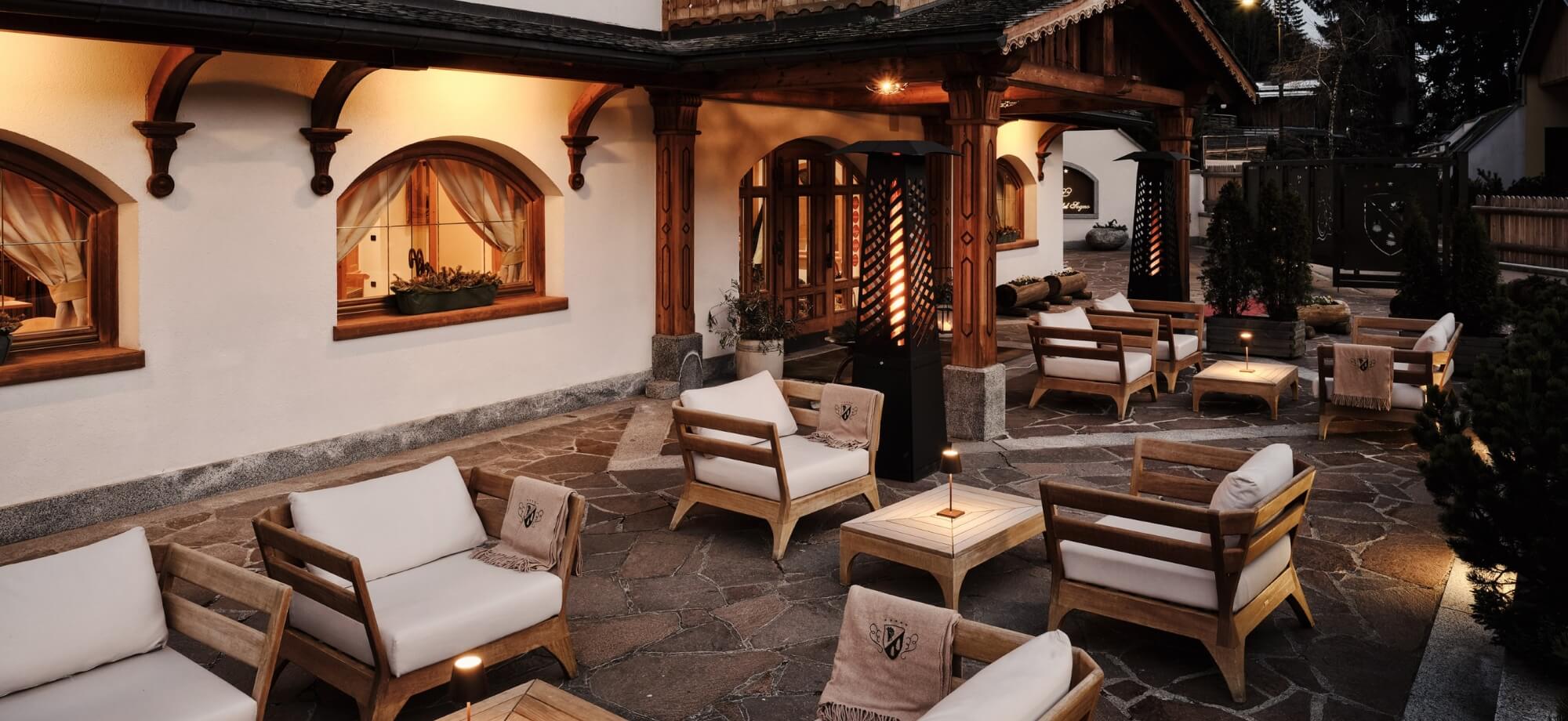
If the choice has landed on Madonna di Campiglio, what is left is deciding where to stay, and the location counts for more than it might seem: from Chalet del Sogno, on Via Spinale a few steps from the lifts, you head out in the morning with your skis on and come back for lunch without ever getting into a car.
For the rest of the planning, the guide to Madonna di Campiglio covers what to do season by season and the page on when to visit goes into detail month by month.