Ski-in/ski-out means one thing only: you leave the hotel with your skis on and you come back the same way at the end of the day. No ski bus, no car, no boots dragging along the pavement. In Madonna di Campiglio, in the strict sense, that applies to very few properties, and they are concentrated in Val di Ser. Everywhere else, Chalet del Sogno included, the right term is ski to door: the piste ends a few metres away and you walk those metres.
The distinction sounds like hair splitting. It is not, because the phrase appears on dozens of listings with different meanings: some hotels sit on the run, some forty metres from it, some three hundred, some rely on the ski bus. From home you have no way to tell them apart, which is why the distance to the lifts is still the single most common question front desks get before a booking. Here is how the basin works, what the four ski areas are, which runs bring you back into the village, and what to ask a hotel to check what it claims.
What ski-in/ski-out means
Ski-in/ski-out means a piste reaches the property and that from the property you can get on a lift without taking your skis off. The two halves sound like one thing. They are not.
Leaving on skis is easy: you only need to be high enough above a lift, or close enough to slide down to the base station. Coming back on skis is rarer, because it needs a run that descends all the way there, open and within reach of the people using it. A hotel can be perfect on the way out and leave you with five hundred metres on foot on the way back.
That is where it is decided. When you read "ski-in/ski-out", the right question is not how far the lift is. It is which run you come back on, and what number it carries.
Ski-in/ski-out, ski to door and "close to the lifts": the difference
Three phrases that read like synonyms. They describe three different things.
Ski-in/ski-out. Skis on in both directions. Zero metres on foot, no transport. It is the rarest case, and it only applies where the building physically touches the line of a piste. In Madonna di Campiglio that happens in Val di Ser.
Ski to door. A piste ends in front of the property, or a few steps away. You take your skis off for a few dozen metres and put them back on. In practice: easy return, departure worth checking. It describes most of the hotels along the rim of the basin.
Close to the lifts. An elastic phrase. It can mean a hundred metres of pavement or seven hundred metres and a road crossing. The only useful units here are the metres stated and the real minutes in ski boots, which are always more than the minutes estimated on normal feet.
Then there is the ski bus, which works well in Madonna di Campiglio and covers the outlying areas. But any form of transport adds waiting and timetables to a day that with children is complicated enough already.
The four ski areas of Madonna di Campiglio: Spinale, 5 Laghi, Pradalago and Grostè
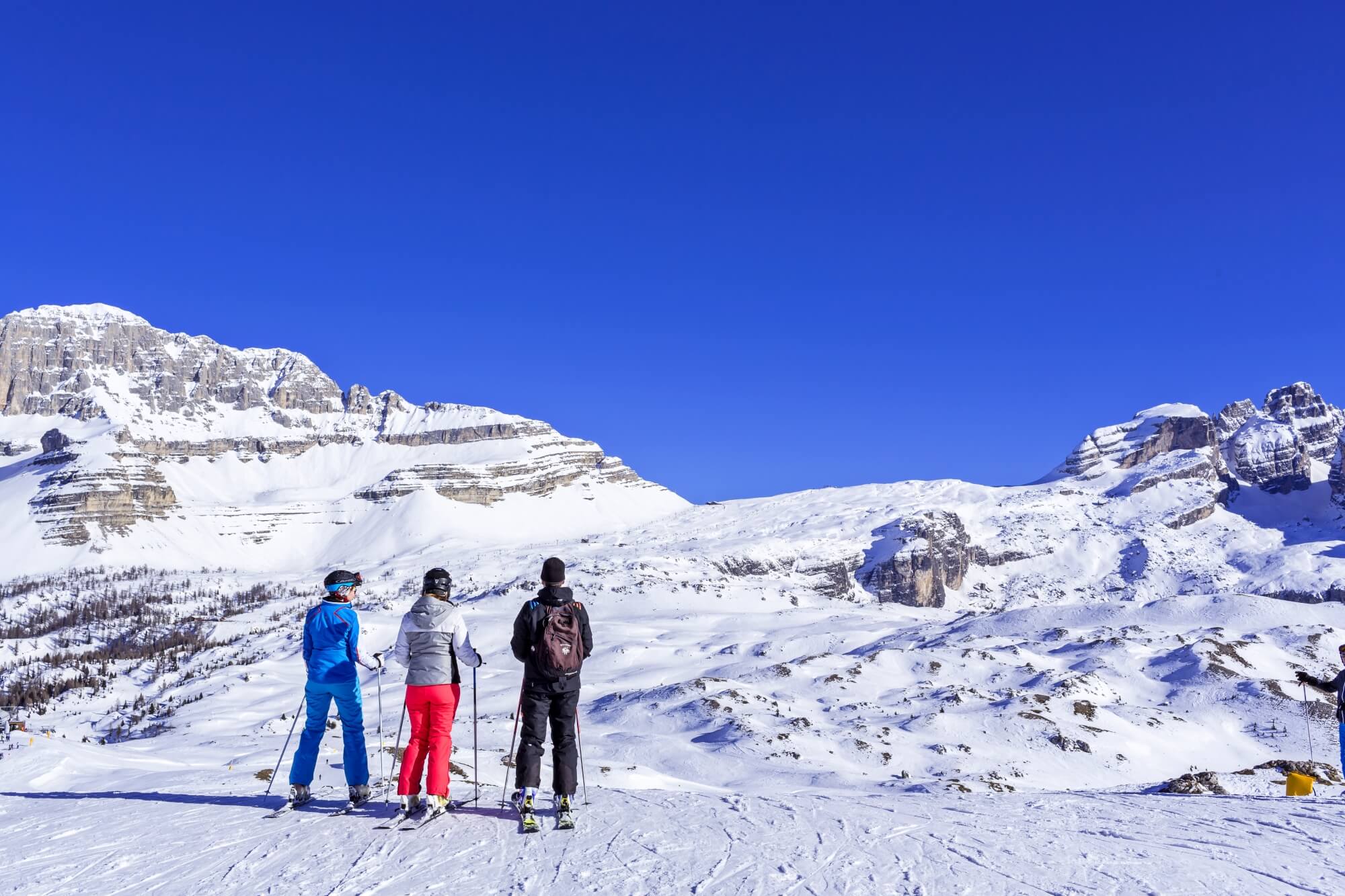
Madonna di Campiglio sits at 1,522 metres (4,993 feet), at the head of Val Rendena, inside a basin. The skiable slopes surround it on several sides, which is why here you ski following the sun instead of spending hours in the shade. There are four main base stations, and the SkiArea Campiglio Dolomiti di Brenta links them all on a single ski pass.
Spinale
The gondola leaves from the village, by the small lake, and climbs to Monte Spinale at 2,100 metres in about 6 minutes. It is the area with the widest gap between its two halves. Up high you find the reds and the blacks: run 73 Spinale diretta, red and wide, and run 70 Spinale direttissima, nicknamed the Schumacher Canalone, whose final wall reaches a gradient of around 70 per cent. Down low, above the village, the runs are blue, served by a dedicated lift designed for beginners and children.
Spinale is also the hub: from here you reach every other area in the basin without taking your skis off.
5 Laghi
Base station in the centre, top station just above 2,000 metres. It is the most technical area in Madonna di Campiglio, and not as a figure of speech: this is where the Canalone Miramonti drops, the final section of the 3Tre, which has had its permanent home in Campiglio since 1957 and has been on the World Cup calendar since 1967. The course dates from 1940 and was designed by Bruno Detassis. The December night slalom is raced there, on the wall that plunges into the village.
Alongside the Canalone are Pancugolo, one of the steepest blacks in the resort, and Centenario, a red running parallel to the Miramonti, named after the hundred years of Madonna di Campiglio.
Pradalago
Base station on the north side of the village, top station at 2,100 metres. It is the gateway to Folgarida and Marilleva: from here you leave the basin and ski across to Val di Sole. It has one single black run, Amazzonia, and it is the most approachable black in Campiglio: a good place to try your first black without frightening yourself. The rest is long, even blues and reds of every kind.
Grostè
The only base station outside the village: the gondola leaves from Fortini, towards Campo Carlo Magno, about a kilometre from the centre. Two sections take you to the 2,500 metres of the Stoppani hut, under the walls of the Brenta Dolomites. Wide runs of intermediate difficulty, easy to ski, and one feature that matters more than it sounds: the sun leaves later here. Altitude and aspect hold the snow longer, and this is the area that copes best with the end of the season.
In total the SkiArea counts 156 kilometres of piste, with a split declared by the local tourist board of roughly 30 per cent blue, 40 per cent red and 30 per cent black.
The four areas compared
The four ski areas of Madonna di Campiglio compared: base station, top elevation, character of the runs and the kind of skier each one suits best. | Area | Base station | Top elevation | Character of the runs | Best for |
| Spinale | In the village, by the lake | 2,100 m | Reds and blacks up high (73 Spinale diretta, 70 Direttissima), blues down low with a beginners' lift | Every level in one place, and the hub towards the other areas |
| 5 Laghi | In the centre | Just above 2,000 m | The most technical: Canalone Miramonti of the 3Tre, Pancugolo, Centenario | Strong skiers, and anyone who wants to see the World Cup slope up close |
| Pradalago | North side of the village | 2,100 m | Long blues, varied reds and one single black, Amazzonia, the most approachable | Skiing out to Folgarida and Marilleva, and a first black run |
| Grostè | Outside the village, Fortini towards Campo Carlo Magno | Up to 2,500 m | Wide and intermediate, and the sun leaves later | Relaxed skiing and late season trips |
Where in Madonna di Campiglio you really ski from the door
The basin explains it. The pistes come down to the valley floor from several sides and stop where the village begins. Properties on the edge of that line have a run that reaches them. Properties in the middle, on the flat, do not.
The hotels that physically sit on the line of a run, the ones for which ski-in/ski-out is accurate to the metre, are in Val di Ser. There are few of them, and it is worth knowing before you book elsewhere expecting the same thing.
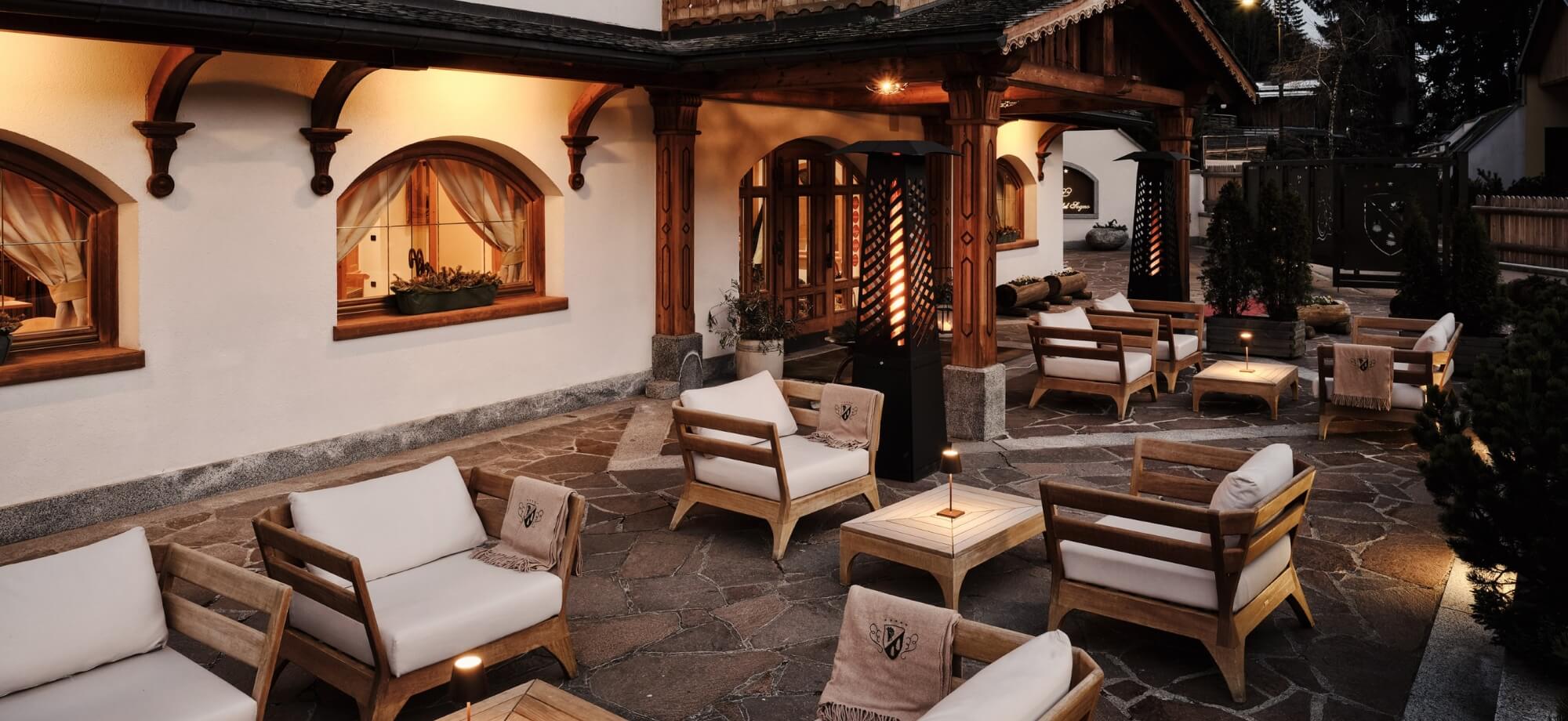
The Spinale side, by the lake, is the other stretch where village and piste come close. Three runs arrive here: 79 Le Grotte, blue, 73 Spinale diretta, red, and 70 Spinale direttissima, black. Chalet del Sogno stands about forty metres from the point where they end, with the Spinale gondola next to the building: forty metres with your skis in hand, not zero. Ski to door, to use the correct term.
Forty metres change little in the real day and change a lot in the choice of hotel, because that is the distance between "the piste ends here" and "it takes ten minutes and a road crossing". The real difference is made by run 79: being blue, it is used by children and by people who have skied for two seasons, so the way home does not depend on the state of a steep wall.
On the opposite side, the Pradalago area has a similar situation shifted further north. The pedestrian centre, with the shops and the squares, is convenient for everything else, but it sits in the middle of the basin: from there it is almost always a few minutes on foot or the ski bus. Grostè is a case of its own: starting outside the village, anyone sleeping towards Campo Carlo Magno is very close to that gondola and far from all the others.
The conclusion: there is no single "lift area" in Campiglio. There are four different base stations, and the right position also depends on where you intend to ski. For the full picture of the resort before you choose, the Madonna di Campiglio guide lays out the rest, and the comparison with the other valleys is in where to go in the Dolomites.
How to check what a hotel claims
Five questions to ask by email or chat before you book. Precise answers come back in two lines, and vague answers are an answer in themselves.
- Which run do you come back on, with number and difficulty. If the answer is a number and a colour, the run exists. If it is "we are very close to the lifts", it does not.
- How many metres you walk in ski boots, out and back. The two figures are often different.
- Where the ski room is, whether it is heated, at what level relative to the piste, and whether you step out from there or from the lobby.
- Which lift is the closest and which of the four areas it opens up, because not all of them lead where you want to ski.
- What happens when the return run closes for wind or thin snow: whether there is a short walk instead or you need the ski bus.
Why a hotel on the piste is the right call with children
Do the arithmetic. Three hundred metres to the lift, twice a day, for seven days: that is 4.2 kilometres covered in ski boots, often carrying a child's skis as well. Written down it sounds like nothing. Lived, it is the difference between a good week and a tiring one.
Then there is the part nobody puts on a postcard: small children do not ski from nine to four. They ski for two hours, they get tired, they get cold, they need the toilet. If going back costs twenty minutes between the walk and the wait, you skip that break and push on until somebody cries. If going back costs three minutes, you go in, change the gloves, have a drink and set off again.
Which is why the colour of the run that arrives matters too. A return on a black is a return children cannot make on their own, and it only works for the adults in the family. A return on a blue works for everyone. For the rest of organising a family week, from instructors to timings, there is the page on the family hotel in the Dolomites.
How much position matters in Madonna di Campiglio
On a map Campiglio looks like a dot, which is where the idea comes from that everything must be close. It is not: the village stretches from the lake to Campo Carlo Magno, and there are two kilometres between one end and the other. Two kilometres in ski boots is not a walk, so from certain positions you genuinely need the car or the ski bus, even though the distance looked like nothing on the map.
Which is why position is measured on the last hundred metres and not in kilometres. What counts is where you step out in the morning, where the piste ends at four, and where the skis sit in between. A heated ski room at piste level shifts the day more than plenty of services that get listed on a page.
There is also a benefit that is easy to underrate: if you sleep on the edge of the piste, you barely need the car at all. No parking to find in the morning, no snow chains, no driving back in the dark on snow-covered roads. Worth keeping in mind when you decide how to reach Madonna di Campiglio.
If you still have practical questions about the ski room, rental, passes and timings, many of the answers are already in the frequently asked questions.