The Dolomites are not one place: they are nine separate mountain groups, split across five provinces and three languages. There is no single best valley, they are all worth the trip. What changes is practical: which ski pass you already hold, how far you travel to ski, what language you hear in the bar and how long the last stretch of mountain road takes.
One name, two systems. To the east sit the valleys around the Sella and Cortina, all inside Dolomiti Superski. West of the river Adige sits the Brenta group, with Madonna di Campiglio, which has its own ski pass and no lift connection to the rest. That is the first decision, and it comes before you look at a single hotel.
Why the Dolomites are not one destination
The Dolomites have been a UNESCO World Heritage Site since 26 June 2009. The listing covers a serial site made up of nine distinct mountain systems, around 142,000 hectares in total, not one continuous chain of peaks.
The site touches five provinces: Belluno, Bolzano, Pordenone, Trento and Udine. The valleys people actually choose between are concentrated in three: Trento, Bolzano and Belluno.
There are three languages too. German is spoken in South Tyrol, Italian in Trentino and the Belluno area, and Ladin in the valleys around the Sella group (Gardena, Badia, Fassa, Livinallongo). The language changes the food, the look of the villages and the names on the road signs.
Which ski pass covers which Dolomites: Skirama, Dolomiti Superski, Epic and Ikon
There are two local pass systems and they do not talk to each other. Dolomiti Superski links twelve ski areas and around 1,200 kilometres of piste on one pass. To the west, Skirama Dolomiti Adamello Brenta is a separate circuit: eight resorts, around 380 kilometres of piste, different card.
Above the two local systems sit the two big international season passes. If you already hold one, your area is more or less chosen.
Epic Pass: seven days at Madonna di Campiglio at no extra cost
The Epic season pass from Vail Resorts includes seven consecutive days at the eight Skirama resorts, Madonna di Campiglio among them, with nothing further to pay. It applies to the full Epic Pass, plus Epic Adaptive and Epic Australia, and not to the Epic Local Pass.
Two practical details that matter on arrival. First, it is not direct to lift. You go to a Skirama ticket office with your physical Epic card and photo ID, and they issue a magnetic key card against a 5 euro deposit, refunded when you hand it back. The app alone will not open the gates. Second, the seven days run back to back with no rest days in between, so plan the week before you fly.
Ikon Pass: Dolomiti Superski
The Ikon Pass covers the eastern side instead. The full pass gives seven days at Dolomiti Superski, the Ikon Base Pass five days with blackout dates, and validity runs from 15 November to 15 April each season. Access here is direct to lift.
In short: Epic takes you to Campiglio, Ikon takes you to the Sellaronda valleys and Cortina. Terms change from season to season, so check your own pass website before you book flights.
What actually changes from one valley to the next
No valley is the wrong choice. What changes is how well it fits you, and that comes down to six concrete things.
- The pass you already hold. Epic sends you west, into Skirama. Ikon sends you east, into Dolomiti Superski. If you hold neither, skip this one and start at the second.
- How far you travel to ski. The Sellaronda is the ski circuit around the Sella massif: four passes (Sella, Pordoi, Campolongo, Gardena), four valleys, around 40 kilometres in a day. You do it with one eye on the clock, because missing the last lift means a taxi home. In a compact ski area you ride up and down without watching the time.
- How many metres sit between your door and the snow. This changes the day more than people expect. Sleep ski-in/ski-out and you never load skis into a car, you can go back at eleven if a child is cold, and in summer you walk out and are on a trail within ten minutes. Where the valley floor is wide, trailheads and lift bases mean a car or a shuttle.
- Language and food. Ladin, German or Italian. This is not folklore: it changes the dinner menu and the look of the villages. Alta Badia gives you canederli and Kaiserschmarrn, western Trentino gives you polenta carbonera and strangolapreti.
- How simple the village is. On that score Campiglio is the easiest of the lot: one basin at 1,522 metres (4,993 feet), shops, restaurants and lifts inside a ten minute walk, and a car that can stay in the garage all week. Resorts strung along a long valley floor work differently, and you move around more.
- How you get there. Verona is about two hours by road, Milan Bergamo around two and a half, Venice a little over three, Innsbruck under three. Most of the Dolomites are reached from the A22 Brenner motorway or the A27 towards Belluno, and the final stretch on local roads is the part that bites: anywhere from twenty minutes to an hour and a half from the exit. The detail for the Brenta side is in the guide on how to reach Madonna di Campiglio.
Two things do not depend on the valley. The date, first: Christmas, New Year, the Carnival week and mid August fill everything, everywhere. Then the season, because some valleys live mainly on skiing and slow down in summer, while others have villages that are lived in all year, nature parks and a trail network that does not depend on the lifts.
The areas of the Dolomites compared
Six areas read the same way: where they are, how you get there, what they feel like, who they suit and who they do not. The summary table is at the foot of the page.
Madonna di Campiglio and the Brenta Dolomites
Western Trentino, in Val Rendena, with Pinzolo about ten minutes away by car. Leave the A22 at Trento or San Michele all'Adige, then roughly an hour on local roads. This is the only Dolomite group west of the Adige, cut off from all the others, and its ski area stands alone: Skiarea Campiglio Dolomiti di Brenta, 150 kilometres of piste linked on skis with Pinzolo, Folgarida and Marilleva, inside Skirama and not inside Dolomiti Superski. This is the area the Epic Pass covers.
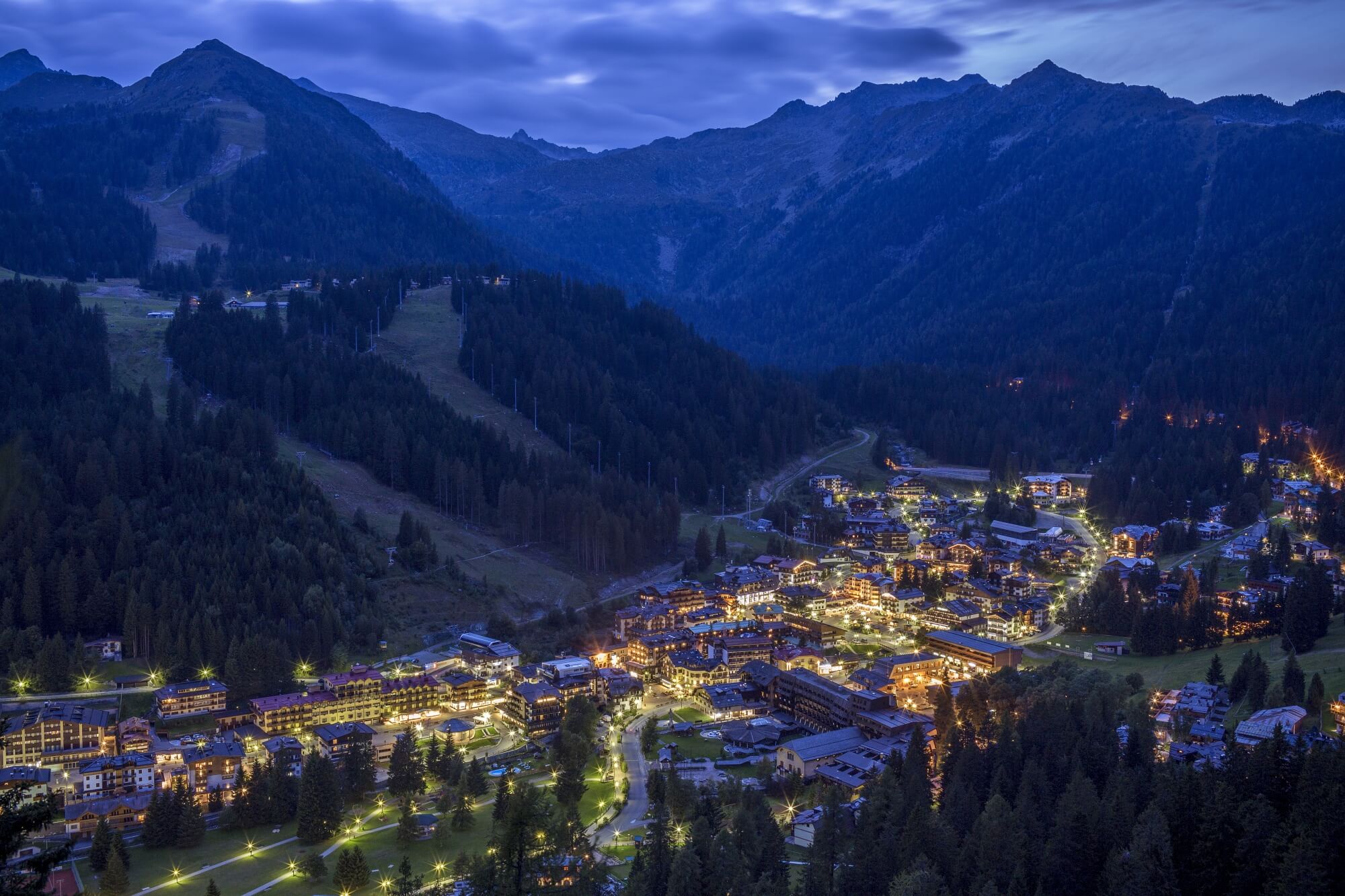
The village sits in a single basin at 1,522 metres and you walk all of it. In summer the trails start where the houses end: you leave the hotel on foot and you are already walking, no car involved.
Choose this area if you want ski-in/ski-out, a compact ski area and a village where the car stays parked all week.
Look elsewhere if you want the Sellaronda, Ladin culture or German-speaking South Tyrol. This is Trentino and the language is Italian.
Val Gardena
Three villages in a row, Ortisei, Santa Cristina and Selva, in the province of Bolzano. You come off the A22 at Chiusa-Val Gardena, then twenty minutes on the valley road. It is the best equipped valley in the Dolomites: lifts in quantity, shops open, something happening in the evening, and the Val Gardena-Alpe di Siusi area is the largest in Dolomiti Superski with 181 kilometres of piste. Ladin, German and Italian sit side by side in the same conversation. From Selva you drop straight into the Sellaronda.
Choose this area if you want lifts in quantity, a village that is alive in the evening and direct access to the Sellaronda.
Look elsewhere if you would rather not move around much. Val Gardena spreads over three villages and a long valley floor, and getting between hotel, lifts and trailheads usually means a car or the ski bus.
Alta Badia
Corvara, Colfosco, La Villa, San Cassiano and Badia, in the province of Bolzano. Leave the A22 at Bressanone-Val Pusteria and climb the SS244, about forty five minutes from the exit. A Ladin valley like Gardena, but with villages spread out rather than one centre holding everything. It sits inside Dolomiti Superski and on the Sellaronda, so the big skiing is all there. The local cooking is a reason to travel in itself, and plenty of people come for exactly that.
Choose this area if you want the big Sellaronda skiing without one centre concentrating everything, and if dinner weighs in your decision.
Look elsewhere if you want a compact village. There are five centres here, spread apart, and in late December and February the circuit also collects everyone moving from pass to pass.
Val di Fassa
From Moena to Canazei, in the province of Trento. Leave the A22 at Ora-Egna, then the SS48 through Val di Fiemme, around forty kilometres. This is the Trentino side of the Sella: same Sellaronda, same pistes, a more Italian feel and villages that stay lived in out of season. Ladin and Italian sit side by side. From Canazei you climb to the Pordoi and the Sella, and it is the easiest starting point if you arrive from the south.
Choose this area if you want the Sellaronda approached from the south, in valleys that stay alive out of season.
Look elsewhere if you want somewhere compact. The valley floor is long and the road between Moena and Canazei makes itself felt in high season.
Cortina d'Ampezzo
Province of Belluno, at the head of the Boite valley. You come off the A27 at Pian di Vedoia and take the SS51 of Alemagna, around seventy kilometres with no passes to cross; from Venice it is a little over two hours. It is the name the whole world knows, with a real town centre and an evening scene no other Dolomite valley has. In February 2026 it hosted part of the Winter Olympics, including the bobsleigh, skeleton and luge events.
Choose this area if you want the international name, a town with a proper centre and life in the evening.
Look elsewhere if your goal is the four passes circuit, or if you want to leave the hotel on foot and find yourself on a trail. Cortina is inside Dolomiti Superski but has no ski link to the Sellaronda, and the basin is wide: pistes and trailheads mean a car or the shuttle buses. The head to head comparison is here: Madonna di Campiglio or Cortina.
Alpe di Siusi and Val di Funes
Two different places answering the same need: landscape without intensive skiing. Alpe di Siusi is the largest high alpine meadow in Europe, 56 square kilometres above Castelrotto and Siusi, closed to private cars from 9 to 5 and linked to Val Gardena in winter. Val di Funes is a farming valley with the Odle peaks in front of it, scattered farmsteads and no large ski area. Both are reached from the A22, exit Bolzano Nord or Chiusa.
Choose this area if you want landscape, walking and a slow pace, with skiing as an option rather than a plan.
Look elsewhere if you want to rack up kilometres on skis. In that case you come here for the day, you do not sleep here.
The Brenta Dolomites: the group west of the Adige
The Brenta Dolomites are the only Dolomite group west of the river Adige. Everything else in the Dolomite imagination, the Sella, the Marmolada, the Tre Cime di Lavaredo, lies to the east. That one detail off the map explains most of the rest.
The group is an island of dolomite rock around 40 kilometres long north to south and 12 wide, closed off by Val di Sole to the north, Val di Non to the east, the Giudicarie valleys to the south and Val Rendena to the west. No road crosses it. It is System 9 of the UNESCO site, the only one of the nine lying entirely within the province of Trento, and it sits inside the Adamello Brenta Nature Park: 620 square kilometres established in 1967, the largest protected area in Trentino, part of the UNESCO Global Geoparks network since 2008.
Being cut off has one practical consequence: the Brenta does not lie on the route that carries skiers from one pass to the next. People who come here chose to come, they do not pass through.
That does not make it a quiet backwater. In winter Madonna di Campiglio is one of the busiest and most international resorts in Italy, with guests from around sixty countries and record first entries in recent seasons. Busy enough that from winter 2025/26 it became the first Italian ski resort to cap daily ski pass sales: the "ideal number" sets a ceiling of 14,000 to 15,000 skiers on the mountain between 11am and 2pm during the New Year and Carnival weeks, based on international research showing skier satisfaction drops above 14,000 on the hill. Season passes, multi-day passes and pay-per-use cards fall outside the cap.
In summer the group changes job. The Brenta via ferrata routes, starting with the Bocchette, are a classic of Dolomite mountaineering, and the park valleys closed to traffic (Vallesinella, Val Genova, Val Nambrone) are why walkers come back. If you want the detail, there are three places in the Brenta Dolomites worth seeing at least once and a description of the area around Madonna di Campiglio.
How to choose the right valley for your kind of holiday
First time in the Dolomites, no fixed idea. The easiest village to read is Campiglio: one basin, everything on foot, a ski area you understand in half a day. If what you want is the classic picture, the Sella and the Sassolungo outside the window, then Val Gardena or Val di Fassa.
Serious skiing, big mileage, the pass circuit. Val Gardena, Alta Badia, Val di Fassa or Arabba, based in Selva, Corvara or Canazei. Inside Dolomiti Superski, on the circuit, on the Ikon Pass if you hold one.
Family with small children. A compact ski area beats a long circuit, and sleeping on the piste beats both: Madonna di Campiglio and the Brenta Dolomites, or Val di Fassa as an alternative. You ski without planning return times and lift closures, and if the afternoon falls apart you walk back to the room. The longer version is on the page about the family hotel in the Dolomites.
A couple after quiet. Val di Funes, Alta Badia outside the peak weeks, or the Campiglio basin in March, when the snow still holds and the crowds have gone: skiing in March in Madonna di Campiglio is one of the least overrated things about the winter. The criteria here are the date and the size of the village, not the size of the ski area.
Summer and walking. Alpe di Siusi for the high meadows, the Brenta for the via ferrata routes and the traffic-free valleys.
Winter without skiing. You need a real village, with something to do when you are not going up the mountain. Ortisei, Cortina and Madonna di Campiglio work; hamlets built around a single lift much less so.
If compact basin, ski-in/ski-out and everything within walking distance sounds like you, you are describing Campiglio. At which point the question becomes a different one: when to visit Madonna di Campiglio.
The areas of the Dolomites compared in a table
The areas of the Dolomites compared: province and language, ski area and pass, character, and the kind of holiday each one suits best. | Area | Province and language | Ski area and pass | Character | Best for |
| Madonna di Campiglio and the Brenta Dolomites | Trento; Italian | Skiarea Campiglio Dolomiti di Brenta, inside Skirama, separate from Dolomiti SuperskiEpic Pass | Only group west of the Adige, compact basin at 1,522 m, everything on foot | Ski-in/ski-out, families, anyone happy to leave the car in the garage |
| Val Gardena | Bolzano; Ladin, German, Italian | Val Gardena-Alpe di Siusi, Dolomiti Superski, on the SellarondaIkon Pass | Large, well equipped villages, heavy international flow | Serious skiing, anyone who wants a village alive in the evening |
| Alta Badia | Bolzano; Ladin, German, Italian | Alta Badia, Dolomiti Superski, on the SellarondaIkon Pass | Ladin valley spread over several villages, serious cooking | Big circuits at a less concentrated pace |
| Val di Fassa | Trento; Ladin, Italian | Val di Fassa-Carezza, Dolomiti Superski, on the SellarondaIkon Pass | Trentino side of the Sella, more Italian in feel | Families, and a first time on the Sella circuit |
| Cortina d'Ampezzo | Belluno; Italian, Ampezzo Ladin | Cortina, Dolomiti Superski, off the SellarondaIkon Pass | International name, real town centre, 2026 Olympic venue, wide basin | Anyone after the headline resort and life in town |
| Alpe di Siusi and Val di Funes | Bolzano; German, Ladin | Alpe di Siusi linked to Val Gardena; Funes with no large ski areaIkon Pass | High meadow and farming landscape, slow pace | Summer, walking, photography, anyone not skiing every day |