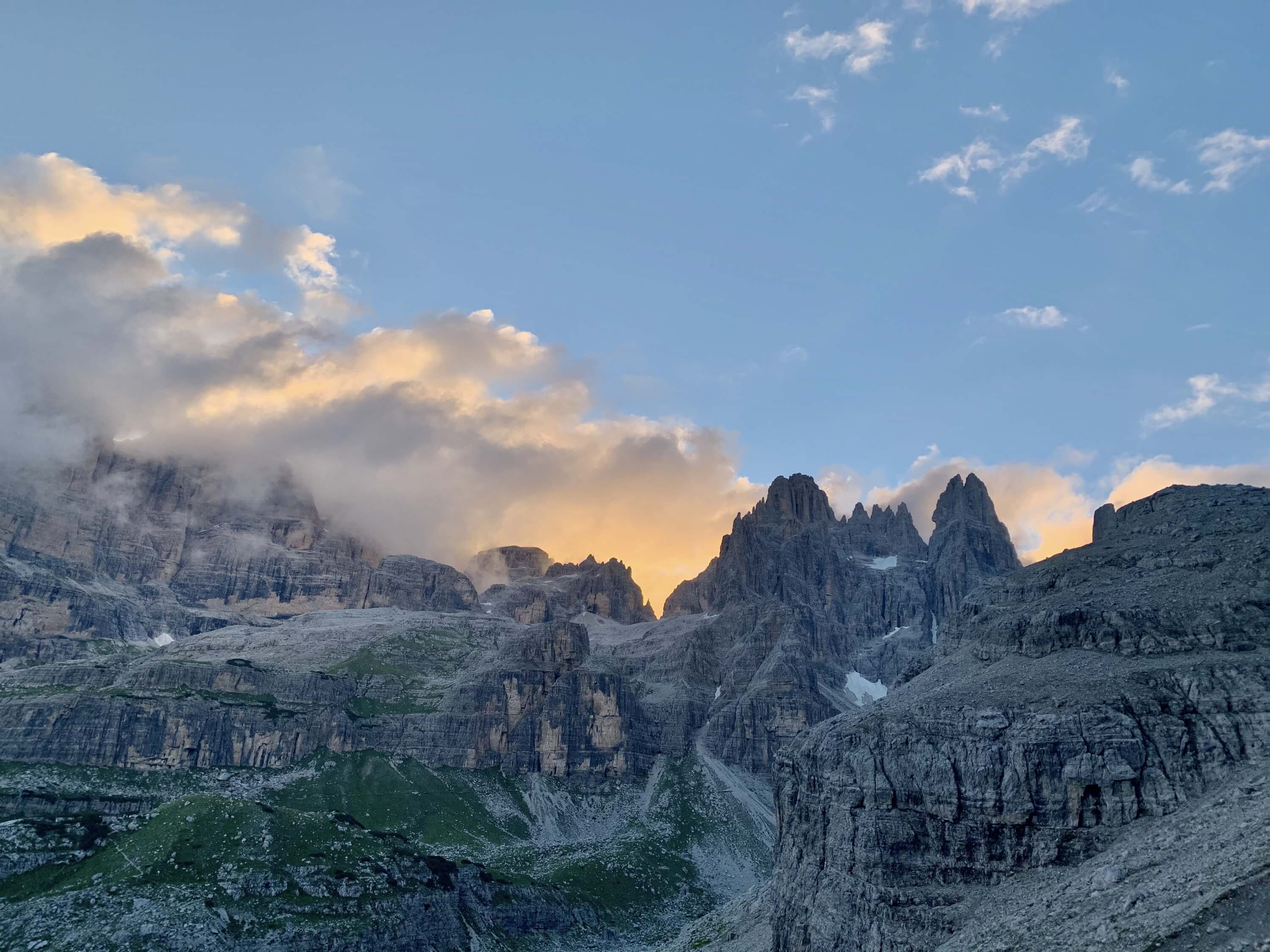

Madonna di Campiglio is an Alpine village in Trentino, northern Italy, at 1,550 metres, set in the upper Val Rendena between the Brenta Dolomites (a UNESCO World Heritage Site) and the glaciers of Adamello and Presanella. The lifts start from the village, the centre is pedestrian, in summer the trails of the Adamello Brenta Nature Park begin right behind the houses, and in winter you ski more than 150 km of connected slopes on a single ski pass.
People call it the Pearl of the Dolomites. That works for the postcard, but the practical point is simpler: here the mountain is not a twenty-minute drive away. It starts at the hotel door.
Madonna di Campiglio at a glance
- Where: Trentino, upper Val Rendena, 1,550 metres. A hamlet of Pinzolo, province of Trento.
- What surrounds it: the Adamello Brenta Nature Park, the largest protected area in Trentino, about 620 km² between the Brenta Dolomites and the Adamello and Presanella glaciers.
- Summer walking: about 450 km of trails. The Five Lakes Loop, the waterfalls of Vallesinella and Val Genova, Lake Nero set in the rock, Rifugio Tuckett and Rifugio Brentei under the Brenta walls, and the Via delle Bocchette, the most famous via ferrata in the Dolomites.
- Summer cycling: Bikeland, the largest bike area in Italy. Cable cars run from mid-June to September.
- Winter skiing from the village: more than 150 km of connected slopes, around 60 lifts, one ski pass.
- Seasons: summer from mid-June to late September, winter from late November to April.
Where Madonna di Campiglio is
Madonna di Campiglio is in Trentino, in the upper Val Rendena, and is administratively a hamlet of Pinzolo, in the province of Trento. All around it lies the Adamello Brenta Nature Park.
The centre is closed to traffic. A bypass with a tunnel and large car parks on the edge of the village keep the pedestrian zone clear: you walk among shops and workshops without meeting a car. It is one of the reasons the village stays quiet in winter, even when it is full.
How to get to Madonna di Campiglio: airports, train, transfers
There is no single right airport for Campiglio. It depends where you are flying from.
Flying in from outside Europe
The two airports with intercontinental routes are Milan Malpensa (MXP), about 280 km and 3 hours 30 minutes by road, and Venice (VCE), about 290 km and 3 hours 30 minutes. Distance and driving time are effectively the same, so choose on the strength of the flight, not the map.
Flying in from within Europe
- Verona (VRN): about 170 km, 2 hours 15 minutes. The easiest of all, mainly European routes.
- Bergamo Orio al Serio (BGY): about 175 km, 2 hours 40 minutes. European network, heavily low cost.
- Milan Linate (LIN): about 230 km, 3 hours. Do not confuse it with Malpensa: Linate is clearly closer, a good half hour less driving, and it handles European and domestic flights.
- Bolzano (BZO): about 110 km, 1 hour 40 minutes. The closest of all, but served by a single airline, SkyAlps, which flies to a handful of European cities including London Gatwick, Düsseldorf and Hamburg. If one of those routes works for you, it is the shortest way in that exists.
By train
The nearest station is Trento, about 70 km and 1 hour 20 minutes from the village, served by Frecciarossa and Italo high-speed trains. From there you continue by bus or private transfer. The last stretch, from Tione upwards, is a mountain road: expect a few hairpin bends.
We arrange private transfers from Malpensa, Linate, Verona, Bergamo, Venice, Bolzano and Trento station. Send us your flight details and we will have the car waiting. There is a full page on how to reach Madonna di Campiglio if you want every option.
Why choose Madonna di Campiglio
In summer you step out of the hotel and you are already inside the park. The cable cars lift you above 2,000 metres in minutes, the trails start from the village and the air stays cool in July, when Italian cities and beaches do not.
In winter the point is skiing from the village itself. The lifts start in the centre and from some hotels, ours included, you ski ski-in/ski-out: no car, no ski bus, skis on your feet in the morning. The ski area is one of the largest in the Alps, more than 150 km of connected slopes across Madonna di Campiglio, Pinzolo and Folgarida-Marilleva, with around 60 lifts.
Then there is the character of the place. Campiglio is elegant but understated, never loud. The pedestrian centre, the shop windows, the pace of the day: nobody here is running for the ski bus.
What to do in Madonna di Campiglio in summer
In summer the Adamello Brenta Nature Park opens about 450 km of trails. The main routes start from the village or from the lifts, which run from mid-June to September.
The Five Lakes Loop, Lake Nero and the high lakes
The Five Lakes Loop, the Giro dei 5 Laghi, is the classic of Campiglio. The 5 Laghi cable car leaves from the centre of the village and climbs above 2,000 metres to Rifugio 5 Laghi. From there an almost flat path reaches Lake Ritorto in a quarter of an hour. The full loop takes in Ritorto, Lambin, Serodoli, Gelato and Nambino: with the lift that is about 460 metres of ascent and five hours of walking with the Brenta in front of you. Five generous hours, if you stop to photograph every lake. You will.
Coming down from Serodoli towards Nambino you pass Lake Nero, a dark basin closed in by rock that is arguably the finest of them all, and that plenty of people miss because they cut the walk short at the lift.
On the Pradalago side there is Lake Malghette: take the cable car to Rifugio Viviani, then path 265 runs almost level before dropping to the lake, with a mountain hut on the shore. It is one of those places where people plan twenty minutes and stay two hours.
The Brenta huts and the Via delle Bocchette
If you want to climb properly, the Brenta walls are an hour's walk from the village. From Vallesinella you go up to Rifugio Casinei (1,825 m), the first hut, the one you can do with teenagers. From there the path splits: on one side Rifugio Tuckett (2,272 m), under the glacier, on the other Rifugio Brentei (2,182 m), with the Crozzon di Brenta closing the valley in front of the terrace. Higher again sits Rifugio Alimonta (2,580 m), the classic base for the via ferrata routes.
And the via ferrata here are a subject of their own. The Via delle Bocchette is the best known in the Dolomites, a cabled route running along ledges across the Brenta massif. It is not a walk. You need a harness, a via ferrata set, a helmet and a head for heights. Without specific experience, go with a mountain guide. We book them.
Easy walks: Nambino, Malga Ritorto, Camp Centener
Not everything here involves a helmet and 800 metres of ascent. Three walks we recommend to almost everyone:
- Lake Nambino (1,718 m), accessible to all. Path B06 starts from the pasture at Patascoss, runs 1.8 km and takes 45 minutes. It was rebuilt free of architectural barriers: it works for wheelchairs, pushchairs, anyone with limited mobility, and anyone who is eighty and still wants to see an Alpine lake. There is a hut on the shore.
- Malga Ritorto, the window on the Brenta. Also from Patascoss, 5.3 km on a shaded road that is almost entirely surfaced and closed to cars in summer. Suitable for wheelchairs too. At the end the whole Brenta chain is right in front of you, and the dairy farm serves food.
- From Monte Spinale to the Grostè across Camp Centener. Take the Spinale cable car and walk an almost level plateau, a natural balcony with Cima Grostè, Cima Brenta and the Crozzon on one side and Presanella and Adamello on the horizon. Very little effort, enormous view.
Vallesinella and Val Genova waterfalls
A few minutes from the village, the Vallesinella waterfall circuit is the classic walk on the Brenta side: water bursting out of the rock and dropping in steps through spruce woods. The route is short and families with children do it easily.
On the opposite side, Val Genova, the Valley of Waterfalls, runs level to the Nardis waterfall, which is more or less the symbol of the park.
Two wheels: mountain biking and road cycling
Here the bike is really two different sports, and it helps to separate them.
On a mountain bike, Madonna di Campiglio belongs to Bikeland, the largest bike area in Italy: around 1,000 km of MTB trails, more than 100 km of easy cycle paths and three bike parks, across a territory that links Val Rendena, Val di Sole and the Tonale all the way to Lake Garda. There are gentle loops through the woods for people who ride on holiday, and serious trails for people who just ride. Rental e-bikes flatten the climbs, and 14 lifts carry bikes.
On a road bike, Campiglio has hosted the Giro d'Italia several times, and the climbs that bring you here are those climbs. But the real gift is the three side valleys with restricted traffic: Val Genova, Vallesinella and Val Nambrone. Good tarmac, almost no cars, a river alongside. You ride hearing water instead of engines, which is a rare thing anywhere in Italy.
If you are coming to ride, have a look at our bike hotel in the Dolomites page: storage, washing and routes are on us.
Golf at Campo Carlo Magno
There is a 9-hole golf course at Campo Carlo Magno, at around 1,700 metres, among the highest in Italy. You play with the Brenta in front of you, and the ball carries further than you expect.
Summer with children
Campiglio works well with a family in summer, and it does not take much planning.
- Montagnoli Adventure Park. At Lake Montagnoli, around 1,800 metres, an adventure park runs through the trees with 8 courses of increasing difficulty and a 120-metre zipline across the lake. Open from age 3, with an adult on the ground for under-14s. The water is green and freezing, and people swim in it anyway. Malga Montagnoli is next door, with a restaurant and a working dairy.
- Conca Verde park, in the centre. A large playground, lawns, tennis courts and the small lake you can loop with a pushchair. This is where children burn off the evening while you stay seated.
- Junior Park above Zeledria. Near Malga Zeledria, a woodland trail with 18 life-size wooden sculptures of Dolomite wildlife: bear, wolf, golden eagle, red deer, marmot. Each animal has its own panel. The gravel surface takes pushchairs and wheelchairs, and on Monday mornings in summer you can walk it with Nature Park experts.
- Cable cars and mountain dairies. The lifts cut out the climbing, Lake Nambino is a short walk, and in the malghe you eat what they make on site.
Our concierge builds the itinerary around the children's ages. Here are the experiences we offer and our family hotel in the Dolomites page.
What to do in Madonna di Campiglio in winter
The slopes of Madonna di Campiglio spread across four connected areas: Grostè, Spinale, Cinque Laghi and Pradalago. For adrenaline there is the 3-Tre on the Canalone Miramonti, a World Cup slalom piste, and the Spinale Direttissima dropping from Monte Spinale into the village.
For snowboarding and freestyle there is the Ursus Snowpark on the Grostè, one of the largest in Europe: 50,000 m² and around forty features. All the detail is on the SkiArea Dolomites of Brenta Campiglio page.
And if you do not ski?
Half of our winter guests spend at least one day without skis on. The alternatives, all minutes from the centre:
- Ice skating on the lake in the village. In winter the Conca Verde lake freezes and becomes an open-air rink, with skate hire, lessons and evening sessions on certain days. The ice is natural, so opening depends on the temperature: ask at reception before you walk down.
- Prepared winter walking trails and snowshoeing. There are groomed paths around the village and up on the mountain. Some days sturdy boots are enough, after a snowfall you want snowshoes. It depends on conditions, and we know the conditions day by day.
- Cross-country, tobogganing and dog sledding. 22 km of cross-country trails at Campo Carlo Magno, a 3 km toboggan run on Monte Spinale, and husky sled outings.
Campiglio, from Sissi to Italian glamour
Campiglio began in the late 1800s as a court destination: Emperor Franz Joseph and Empress Sissi stayed here, and the village still marks that Habsburg chapter in February with the Habsburg Carnival and the Emperor's Grand Ball.
But the Campiglio you visit today was built later. In the 1960s and 1970s it became the mountain resort of industrial Italy: northern industry, the Italian ski week, a long association with Fiat and Ferrari, the shop windows in the pedestrian centre. That is where its character comes from, and that is what separates it from the resorts of Alto Adige, which speak another language and have a different aesthetic. Here the food, the language and the style are Italian, even when half the guests are not.
If you are weighing up destinations, we wrote a page on Madonna di Campiglio or Cortina.
When to go to Madonna di Campiglio
The summer season runs from mid-June to late September, the winter one from late November to April. Inside those two windows, the right time depends on what you want.
In summer, July and August give you cool mountain air while cities and beaches bake, and everything is open, huts included. June and September are the quiet months, ideal for walking and riding with the park almost to yourself. In early June, though, the lifts are still closed and there can be snow up high: ask us and we will tell you what is already walkable.
In winter, December, January and February are the ski high season. March is the month most people underrate and the one we recommend: long days, sun, slopes still in excellent condition and far fewer people. You ski in the morning and sit in the sun on the terrace in the afternoon. Month by month, it is all in our guide on when to visit Madonna di Campiglio.
Where to stay: Chalet del Sogno as your base
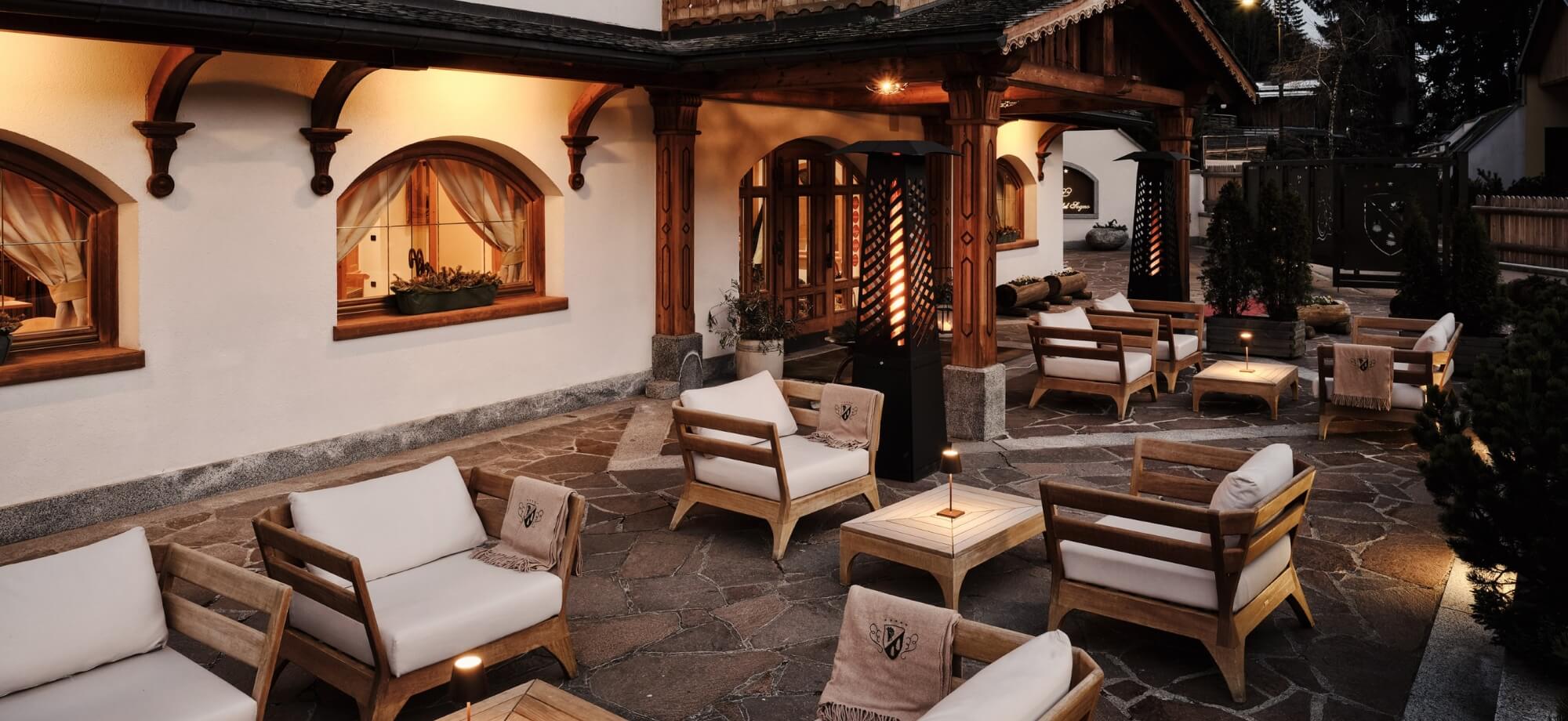
The Chalet del Sogno is a 5-star hotel owned by one family, with 18 suites and a team of around 30 people. No chain, no manager who changes every season: the people who welcome you are the people who decide.
We are on Via Spinale, right next to the Spinale cable car, one of the two main lifts leaving from the village. Not five minutes away, not a short walk: next to it. In winter that means skis on at the door, ski-in/ski-out in the literal sense. In summer it means the cable car to altitude is the first thing you see when you step outside. The building is made in bioarchitecture and heated by geothermal energy.
Inside there is the Oasi del Sogno spa, with a heated indoor pool, Finnish sauna and Turkish bath: after the Five Lakes Loop or a day in the saddle, the pool earns its keep. On the ground floor is Due Pini, contemporary Alpine cooking with Trentino ingredients. The suites are soundproofed and drawn from the flora and fauna of the Dolomites.
To come at the right moment, have a look at the seasonal offers. If you already have dates in mind and want to know whether they make sense, write to us. We will tell you even when the answer is "come a different week".